5 Fall Essential Oil Blends to Copy
I make scented candles with essential oils for a living. I’ve tested too many blends to count by now. Here are 5 of the best fall essential oil blends I’ve tried, plus the exact formulas to replicate to really switch things up in your home.
First, How To Mix Essential Oils
Before we get into drop counts, you must first understand the science behind blending essential oils. If you’ve heard about fragrance notes in perfumery, the same applies here.
When blending essential oils, a great starting point is to follow the fragrance note categories (top, middle, and base). Getting familiar with the essential oil notes you’re working with will help you create a well-balanced blend, maximize the benefits of each oil, and save you money on fragrance tests.
What Are Fragrance Notes? + Cheat Sheet for Blending
Fragrance notes are the building blocks of an aroma and slowly unfold over time, revealing different layers of a scent.
Top notes are what you smell first. They’re light and fresh, and they evaporate first to reveal other layers. These notes primarily include citrusy oils (lemon, bergamot, sweet orange) and mint, and they work best at 30% in a blend.
Middle notes are the true superstars and start to develop after top notes fade. They make up the core of a blend at 50%; they’re bold, warm, floral, and spicy. Common examples include lavender, rosemary, sage, jasmine, geranium, and ylang-ylang.
Base notes are the slowest evaporating oils. They anchor a scent’s character, giving it depth and longevity. Common examples are frankincense, cedarwood, vanilla, and patchouli. These make up only 20% of a blend.
Some oils (like tea tree, basil, or ginger) can act as a top or middle note, but it all depends on the blend. Once you’re comfortable with the 30/50/20 breakdown, feel free to try different combinations. You’ll be surprised at what you end up with once you play around with these percentages!
5 Fall Essential Oil Blends
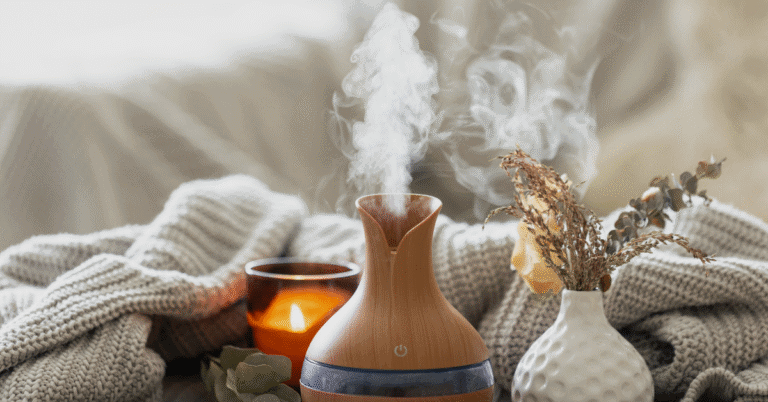
These recipes are written for an ultrasonic diffuser. Capacities vary so scale as needed. A general rule of thumb is 5 drops per 100ml of water. Always remember to clean the reservoir between blends to keep it from turning stale.
- All Spice
There’s something about fall and spice that just fits so well. There are so many great combinations to try, and this one is one of our favorite essential oil fall blends:
- 100ml water
- 1 drop of Ginger Essential Oil
- 2 drops of Clove Leaf Essential Oil
- 1 drop of Nutmeg Essential Oil
- 1 drop of Frankincense Essential Oil
- Vanilla S’mores
Everything you’d want in a dessert and none of the dishes.
- 100ml water
- 1 drop of Sweet Orange Essential Oil
- 2 drops of Ginger Essential Oil
- 1 drop of Cinnamon Essential Oil
- 1 drop of Vanilla Essential Oil
- Chunky Sweater
This recipe is for the fall nights, where we throw on our sweaters, and have a nice, cozy night in.
- 100ml water
- 1 drop of Bergamot Essential Oil
- 2 drops of Clove Leaf Essential Oil
- 2 drops of Vetiver Essential Oil
- Cold Snap
Some mornings you need to be awake, not just up. Let eucalyptus and grapefruit do the heavy lifting, while cedarwood keeps you steady.
- 100ml water
- 1 drop of Grapefruit Essential Oil
- 1 drop of Eucalyptus Essential Oil
- 2 drops of Nutmeg Essential Oil
- 1 drop of Cedarwood Essential Oil
If this one becomes your fall blend, the candle version swaps cedarwood for Haitian vetiver and it’s much smokier. A staple in our home.
- Porch Lights
By November, the sun is gone before you sit down for dinner. This one helps you make peace with it.
- 100ml water
- 2 drops of Sweet Orange Essential Oil
- 2 drops of Lavender Essential Oil
- 1 drop of Cedarwood Essential Oil
Final Thoughts On These Fall Essential Oil Blends
There you have it—five of our favorite essential oil blends. Alternatively, you can also mix any of these formulas into two teaspoons of carrier oil like jojoba or grapeseed and use on the body.
For the spice-heavy blends, use 4 teaspoons instead. Cinnamon, clove leaf, and nutmeg are all dermal sensitizers, so they need the extra dilution. Bergamot and grapefruit are also phototoxic—they react with UV light and can burn the skin. If wearing either one, stay out of direct sunlight for 12 to 18 hours. And, always do a patch test before putting oils on your skin.
If candles are more your jam, our Fall and Stress Relief blends are in the shop.